Solving Scheduling Challenges?
I am glad to discuss constraint formulation, solver heuristic tuning, and high-dimensional optimization systems.
Get In Touch
Loading

Amberdots (Amberdots Concepts) is a digital agency and product studio focused on building practical software systems, web applications, and technical solutions.
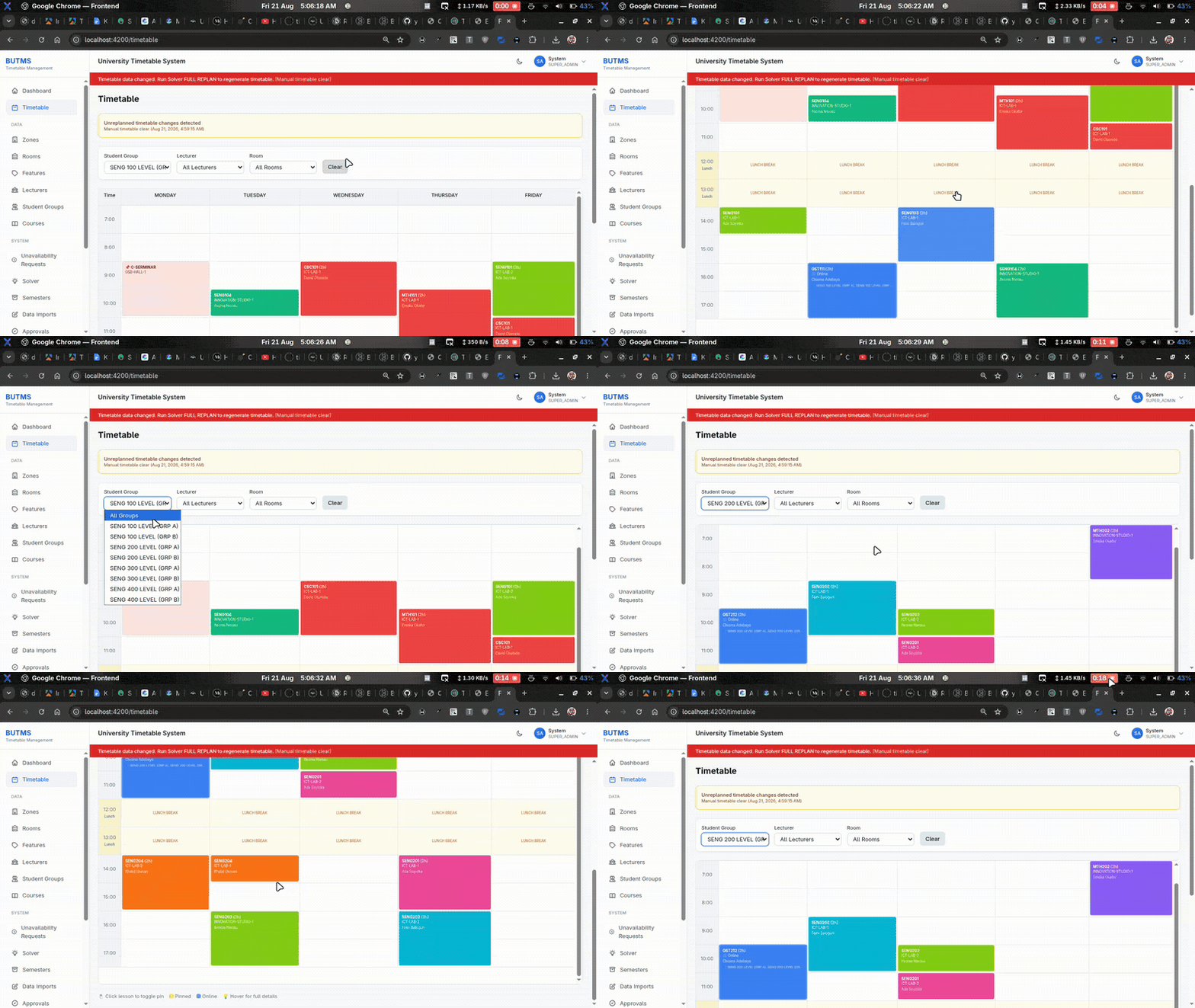
A university timetable system that uses Timefold constraint solving to automatically generate conflict-free academic schedules at institutional scale. The system coordinates courses, room capacities, campus zones, lecturer availability, and student group cohorts—transforming a complex manual ordeal into an automated solver run.
Creating a university timetable sounds deceptively simple until all competing variables are cataloged: classes need specific rooms, lecturers have restricted working timeslots, cohorts have overlapping course registrations, and rooms possess varying capacities and specialized amenities. In many institutions, administrative staff spend two to four weeks manually wrestling with timetable grids, only to encounter room clashes and instructor conflicts on the first day of lectures.
I set out to engineer an automated scheduling engine that formulates timetable generation as a mathematical constraint satisfaction problem (CSP), programmatically searching for optimal configurations rather than relying on manual trial and error.
Administrators configure courses, student groups, lecturers, rooms, campus zones, and available timeslot periods. The system executes through a rigorous multi-stage pipeline:
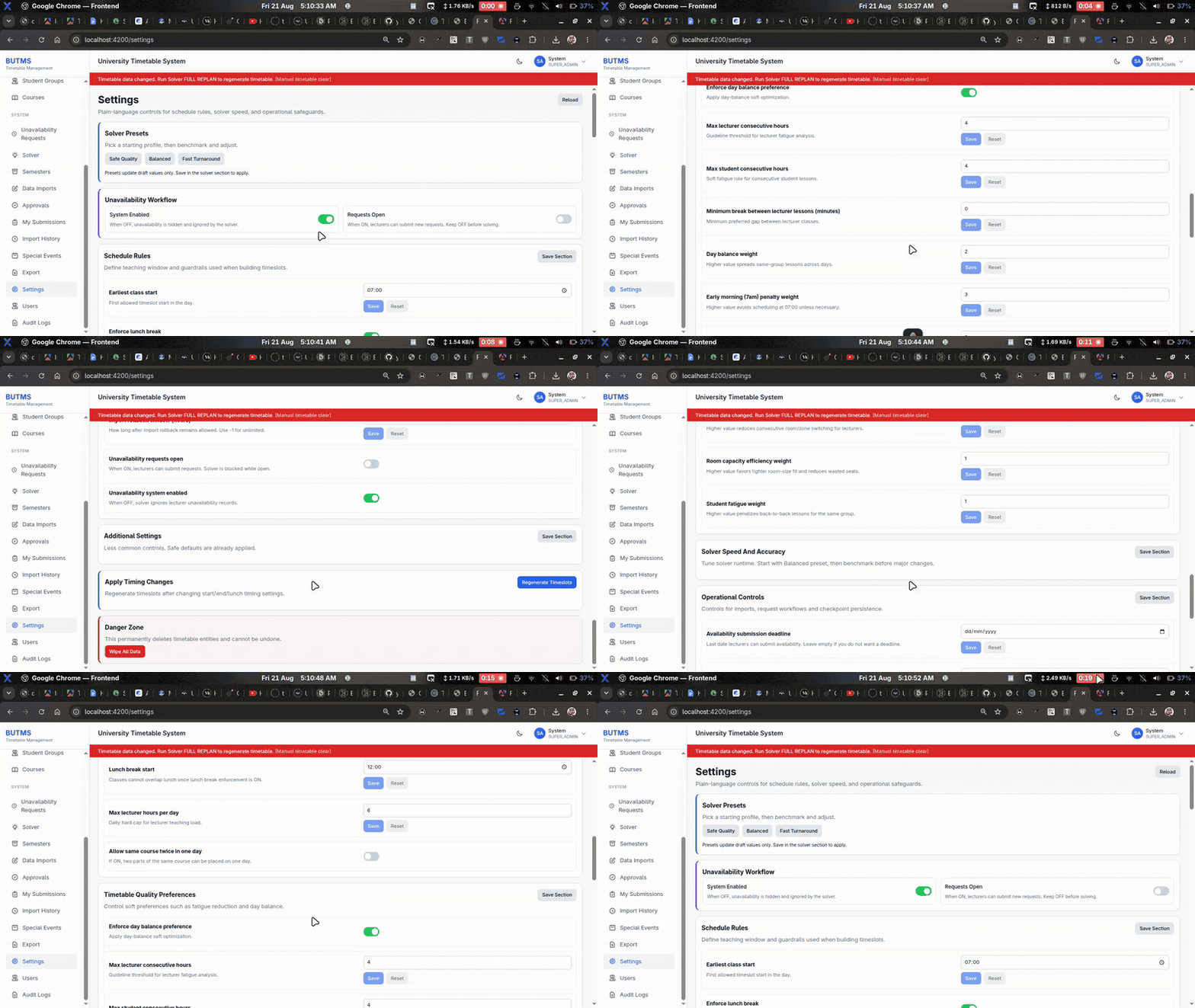
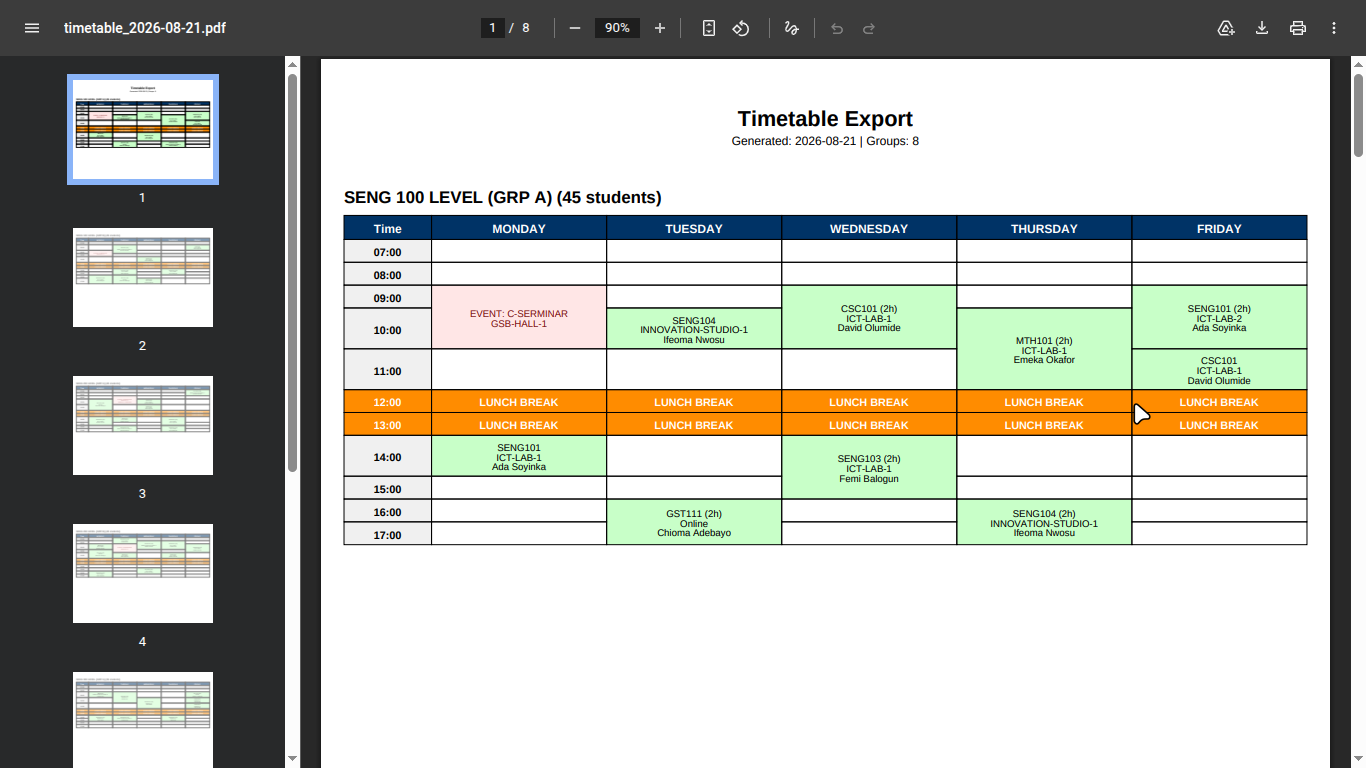
The critical engineering challenge was structuring constraints so that generated schedules are not just mathematically valid, but pedagogically practical:
Building a constraint-based timetable engine taught me that solving complex software challenges is not just about finding any valid permutation; it is about accurately modeling competing real-world constraints and engineering efficient search strategies that consistently produce practical, balanced solutions.